 0M Bid for Spirit Airlines Data as Enterprise AI Inference Costs Surge" style="display:block;width:100%;height:auto;border-radius:14px;margin:0 auto;" />
A major shift in enterprise artificial intelligence is underway as tech leaders compete for real-world operational data while battling escalating model usage costs. Google recently secured a $10 million deal to acquire the historical operational records of bankrupt carrier Spirit Airlines, outbidding a $7.5 million offer from Mercor.
At the same time, businesses are confronting a growing financial challenge: despite a 97.5% decline in per-token model processing prices over three years, total enterprise AI bills continue to climb rapidly due to unmanaged inference demand and inefficient routing architectures.
Google Acquires Spirit Airlines' Enterprise Operational Data
The bidding contest for Spirit Airlines' operational archive highlights an increasing demand for enterprise operating history among AI developers. Pending bankruptcy court approval, Google's $10 million acquisition includes a comprehensive dataset of internal organizational assets:
- Approximately 100 million employee emails
- Around 500 million Microsoft Teams messages
- Over 30 million customer-service call recordings
- Pricing, revenue-management, operational records, and software assets
The deal explicitly excludes passenger profiles and loyalty-program records, and the included data will be de-identified. While frontier AI developers previously relied heavily on public internet scraping, operational datasets offer specific context on how organizations make decisions, adapt to disruptions, and handle complex real-world edge cases across decades of business operation.
The Paradox of Falling Token Prices and Rising AI Bills
While access to high-value training data becomes more competitive, managing continuous model execution—known as inference—has emerged as a major enterprise expense. Inference costs at scaling AI firms average 23% of total product costs.
Although token costs dropped from roughly $30 per million tokens in 2023 down to $0.75 in 2026, corporate spending on AI inference has consistently grown. This expansion is largely driven by multi-step AI agent workflows where a single user prompt can trigger 6 to 15 automated model calls, repeatedly resending context and consuming tens of thousands of tokens per interaction.
Model Tiering and Vendor Pricing Structures
Pricing changes from leading AI developers further reflect these dynamics. On July 30, OpenAI reduced its entry-tier pricing by 80% while holding its flagship model price steady. On August 13, OpenAI previewed an Ultrafast tier running on Cerebras hardware, delivering flagship capability up to 14 times faster at 750 output tokens per second at premium pricing.
Similarly, OpenAI's Fast tier offers up to 2.5 times quicker output speeds at double the standard price. Rather than lowering high-end operational costs, processing efficiency gains are frequently packaged into premium performance speed tiers.
Industry Adaptation and Cost Optimization Strategies
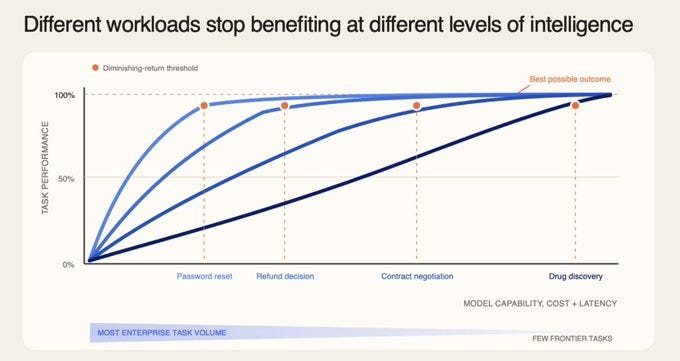
To prevent routine tasks from defaulting to flagship models, companies are rethinking request architectures. The significance of model selection infrastructure was highlighted on August 19, when Stripe agreed to acquire OpenRouter, a service that routes requests across hundreds of models for approximately 10 million users.
Data shows a stark difference in spending: companies using tiered serving architectures averaged $2.31 per million tokens, compared to $18.40 per million tokens for organizations routing all requests to flagship models.
Four Key Levers for Enterprise AI Cost Optimization:
- Prompt Caching: Structures system instructions to reuse cached prompt elements at roughly one-tenth of standard rates.
- Tiering and Cascading: Routes routine tasks (extraction, classification) to smaller models, escalating to flagship reasoning models only when confidence scores are low.
- Batch Processing: Executes non-urgent overnight evaluations and background work via batch tiers at 50% discount rates.
- Organizational Context Layers: Uses context graphs to supply models only with specific required parameters, cutting prompt sizes from 50,000–150,000 tokens down to around 25,000 tokens on large databases.
Summary
As Google's bid for Spirit Airlines' data demonstrates, real-world corporate operating histories hold substantial value for training future AI models. Meanwhile, managing enterprise AI implementation effectively requires balancing raw model capability against practical execution costs, ensuring that specialized intelligence is deployed efficiently across business workloads.